Jakarta’s reform plan is unlikely to reverse MSCI to move Indonesia to Standalone Market status by 30 June 2027.
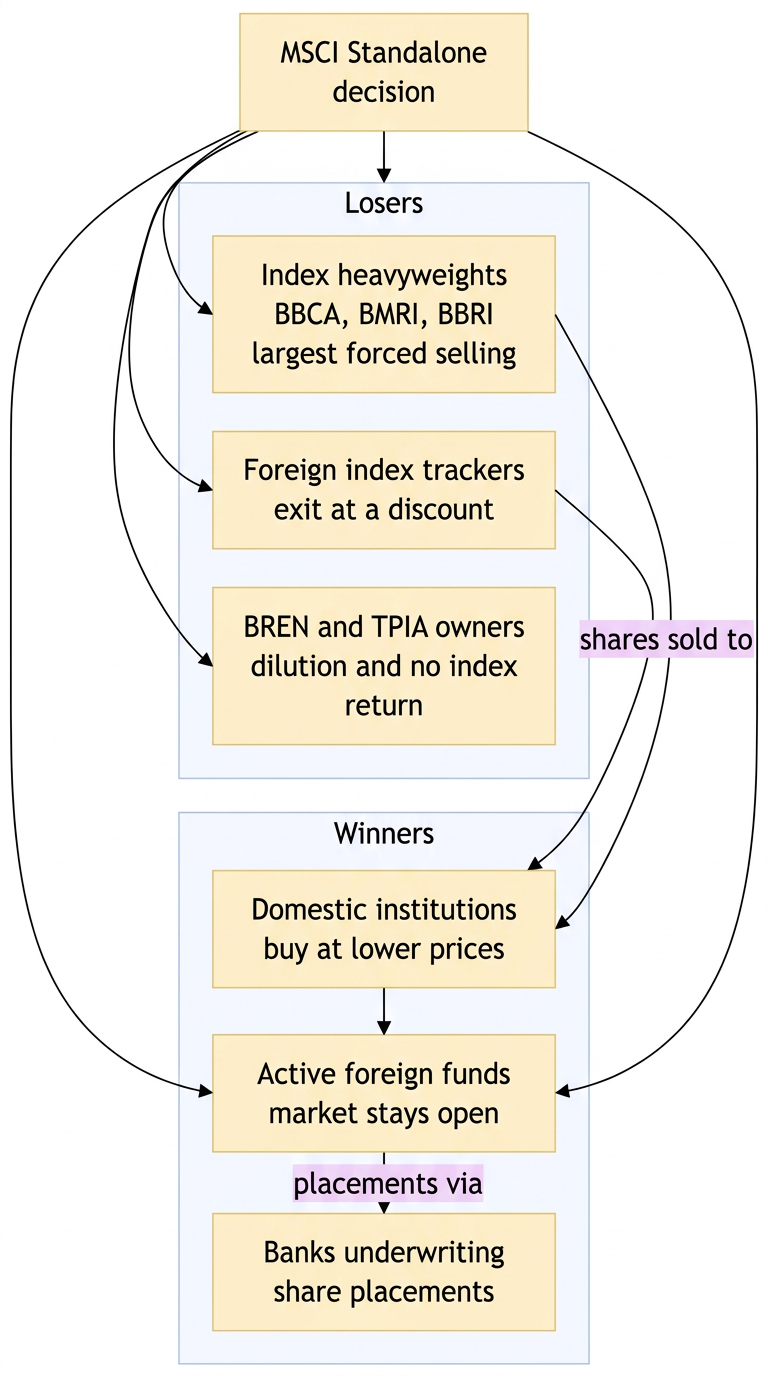
On 27 October 2026, Jakarta restated its reform plan: a 15% minimum free float, an audit of beneficial ownership and a joint enforcement task force. Officials also said Indonesia will do what suits the national interest, whatever MSCI decides. MSCI's 15 October proposal already says it will proceed unless feedback shows clear, material improvement by 30 April 2027. Reforms that are announced but not yet enforced do not meet that test. The mid-cap exposure comes from the transition rules. Large companies with free float below 12.5% have until March 2027 to reach 12.5% and until March 2028 to reach 15%. Until then, MSCI's freeze stays in place and cuts foreign weights without adding any buyers. The biggest losers are families controlling Indonesia’s major conglomerates, particularly Prajogo Pangestu’s Barito Renewables (BREN) and Chandra Asri (TPIA). Their publicly traded shares account for just 12.3% and 10.6% – below the 15% minimum. A downgrade to Standalone status could force passive funds to sell around US$4.5 billion in Indonesian stocks, while Goldman Sachs estimates US$7.8 billion under a frontier-market scenario.
Ask Bilbyabout it
Carry the prediction into a question: what has changed since, who decides, and who is exposed.
More from Indonesia
29 predictions on Indonesia so far, newest first.
See what we’reseeing next.
New predictions in the Asia Daily Take, free every weekday, and in Bilby whenever you have a question.
Get the Asia Daily TakeTry Bilby